Tuesday, May 30, 2006

Indian Natives of Bombay


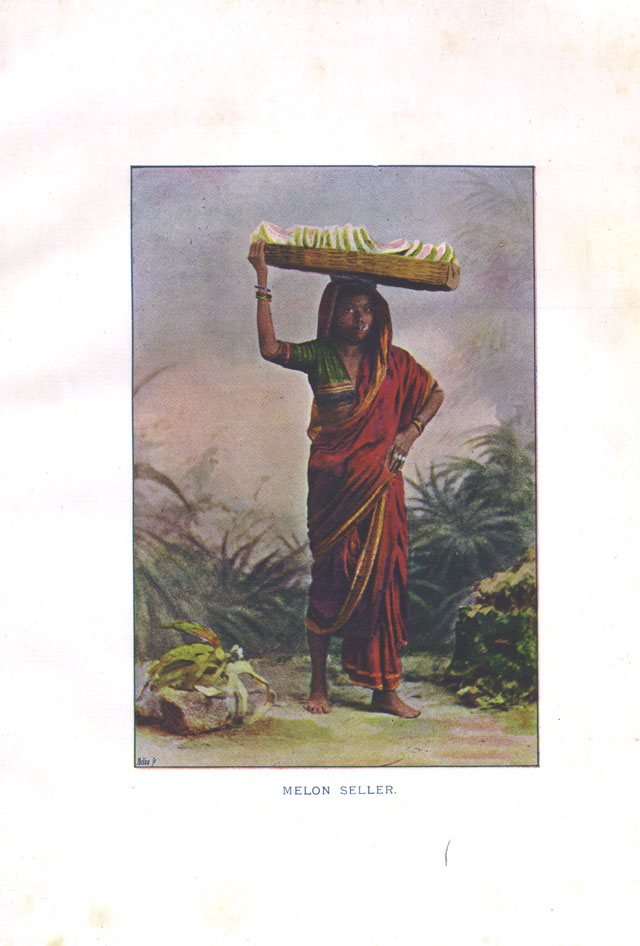
Native Water Mellon Seller

“This picture represents a woman of the Koolmbi caste, who is by no means to be confounded with a coolie. A very low caste woman would find but few purchasers for her wares, which, being edible, nobody would buy from a person whose social status was not considered sufficiently high.
[…] Although not a very cheap luxury, there are many varieties when in season, the mango ranking among the most expensive and best appreciated. Pineapples are plentiful, and oranges can be had all year round from Nasik or Nagpur. Apples, too, from Cabul, but only fit for puddings. Green figs, melons, pappiya, and bread-fruit are also to be bought in their respective seasons."

in Coleman, F. M., Typical Pictures of Indian Natives Bombay: "Time of India" Office, and Thacker & Co. 1903
Tuesday, May 23, 2006

Indian Natives of Bombay


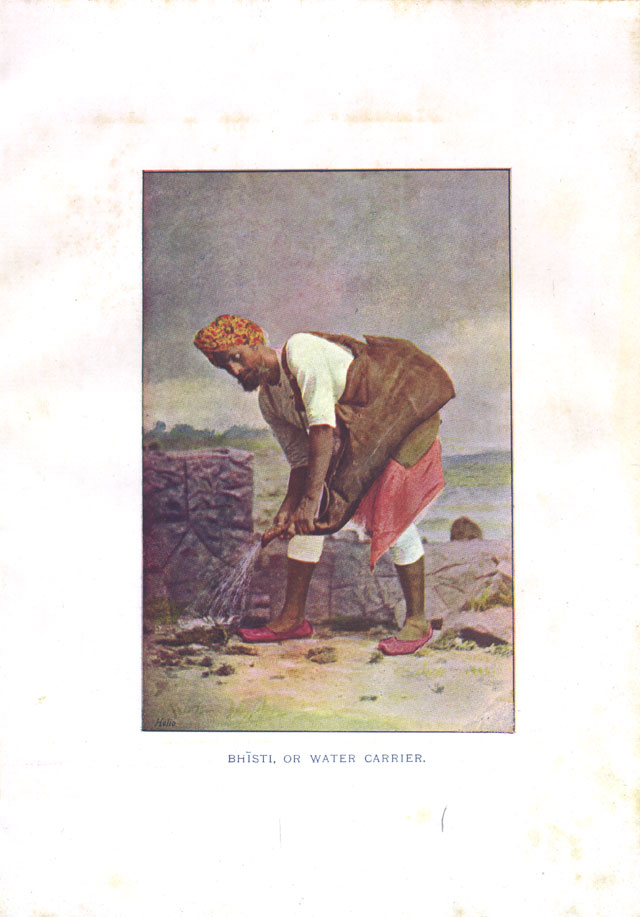
Native Bhisti of Bombay

“A very useful man is the Bhisti, and, relatively speaking, a hardworking individual. He carries upon his hip the entire skin of a goat, the body and legs of which are sewn up, the neck only being left open. This is called a mussock, and it is with this utensil that he performs the many duties of his calling.
It might be supposed that for the purpose of carrying water from one place to another, a pail would be a more convenient article […]. There was once a planter who – being new to manners Eastern – thought to economise time and labour by providing his coolies with wheelbarrows, in place of the little baskets with which labourers customarily transport earth. On going to see what strides the sources of civilization had enabled them to make with their work, he found the coolies carrying the barrows on their heads […]."

in Coleman, F. M., Typical Pictures of Indian Natives Bombay: "Time of India" Office, and Thacker & Co. 1903
Monday, May 22, 2006

Indian Natives of Bombay


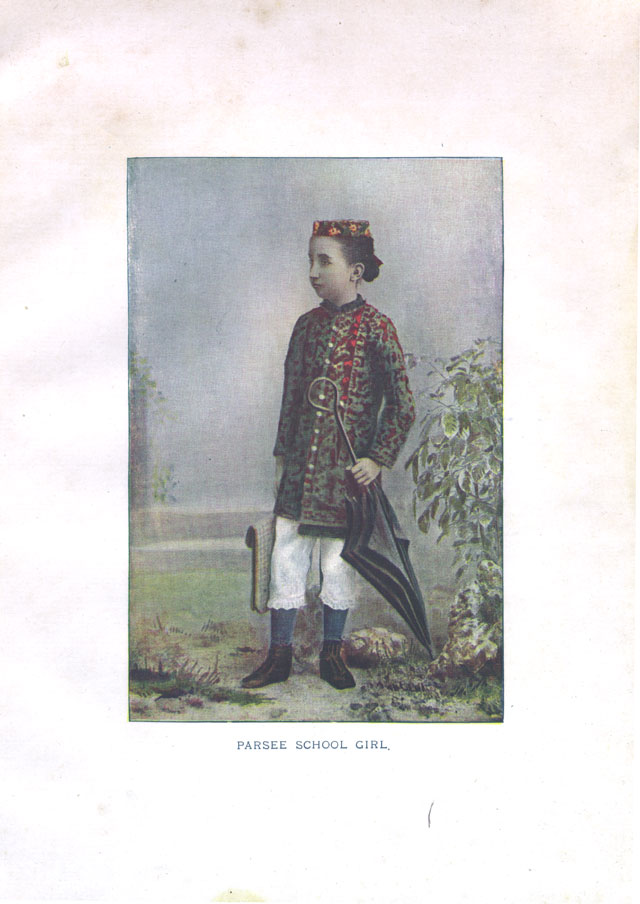
Native Parsee Girl

“Among the many strange costumes which attract the eye of a new comer, few appear so grotesque as that of the Parsee young lady, when at that stage of her existence which is prior to the assumption of her outer garment.
[…] Her jacket may be of cloth, or of cotton, or silk, according to the season, but is always cut in the same style, falling just below the waist.”

in Coleman, F. M., Typical Pictures of Indian Natives Bombay: "Time of India" Office, and Thacker & Co. 1903
Friday, May 19, 2006

Indian Natives of Bombay


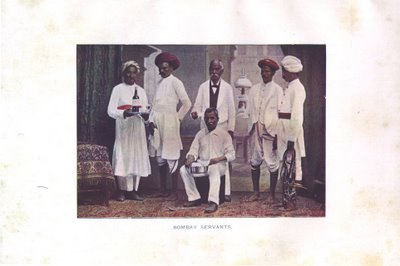
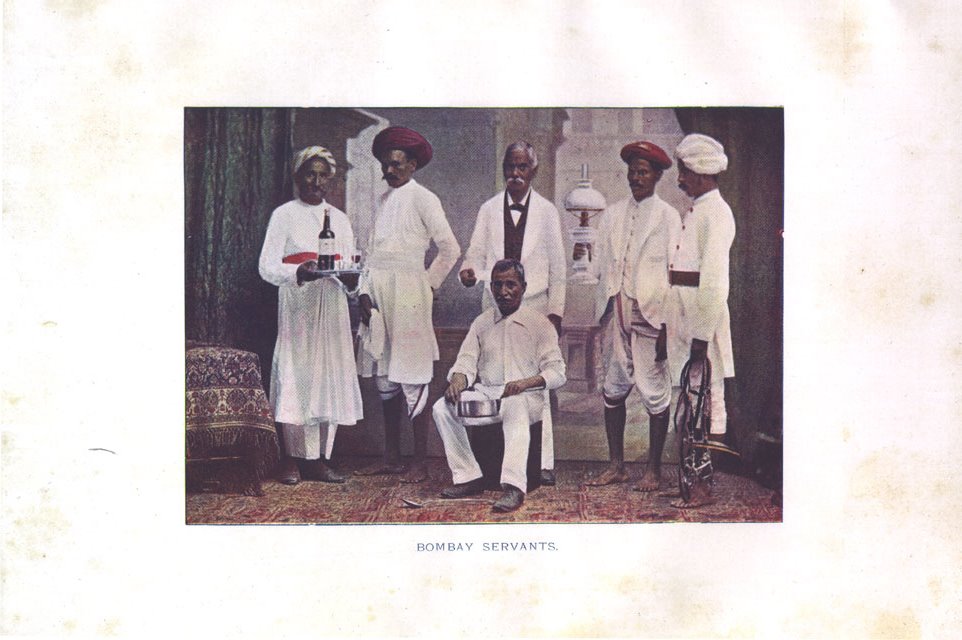
Native Servants

“It has been said, with some amount of truth, that natives of India make excellent servants, but one of the qualifying conditions lies in the necessity of knowing how to manage them. […] For while a man always robs you over the monthly bazaar account to the utmost of his ability, he may be above suspicion – but this is not to be regarded as a certainty – in the matter of money or valuables entrusted to his care.
The number of servants in various households differs to a great extent, but the smallest bachelor establishments usually find it necessary to employ at least five persons, of which the butler, or ‘bootliar’ as the native has it, is the chief. It is he whose proud privilege it is to go each morning to the bazaar […]. As it is a matter of impossibility for Europeans to ascertain the actual prices of things sold in the bazaar, these never remaining the same for two days together, it may be imagined that the daily statement purchases opens out a wide field for enterprise on the part of the butler, of which he is not slow to take the fullest advantage.

The marketings cannot be undertaken without the aid of a coolie […]. The cook has a mate, be the household ever so small […].it is necessary to employ a hamal – a gentleman whose chief duty would appear to be, if may be judged by his actions, to flick the dust from one part of the room to the other, to mix up the paper’s on one’s desk in extricable confusion, and removing certain books from their places, to carefully replace them, bottom uppermost. […] The work of the bearer, or dressing boy, is to lay out your clothes in the morning, to put the studs in your shirt […]. He waits upon you at the table and considers that this and the task previously detailed constitute a day’s labour sufficiently arduous for any one man.
The syce, or groom, is a necessity in most bungalows, despite the advent of the bicycle .[…] The centre figure is the cook, a Goanese, as is also the dressing-boy in his rear – beside him being the hamal, the butler completing the list.”

in Coleman, F. M., Typical Pictures of Indian Natives Bombay: "Time of India" Office, and Thacker & Co. 1903
Thursday, May 11, 2006

Sir R.F.B. (1821-1890)


...before middle age, he had compressed into his life "more of study, more of hardship, and more of successful enterprise and adventure, than would have sufficed to fill up the existence of half a dozen ordinary men"...